What are the latest trends in furniture eCommerce? UX Agency assesses the eCommerce industry

More and more people are shopping online. According to Shopify Global e-commerce is developing like never before, which can be seen above all in the furniture industry.
Ecommerce Statistics Report 2020 shows how hugely impacted this has been by the COVID-19 pandemic. Probably not just because online shopping was the safe and often the only way to get products. It may also be because people are forced to spend the majority of their time at home. Quite a few studies say that they also began to pay more attention to the surrounding environment in the “four walls”.
For many, there was a strong need to build a pleasant nest and organize a practical space for work, study or other activities. Home space has become one of the most important for investment.
According to Emizentech Online sales account for more than 90% of the growth in the furniture e-commerce industry, so especially now it is worth taking care of the proper development of your e-commerce site so that it complies with the latest trends and stands out from the competition.
Of course, here it is important to remember the essence of studying the user experience of a given store in order to properly match the given market trends. Without the use of proper process and methods, alone Trending will not contribute to success.
In winter we have a lot of experience in this area. That is why we have selected the most important trends for you and pointed out the biggest mistakes that stores can make in adapting them to their customers.
Furniture eCommerce Trends — What Should You Look Out For?
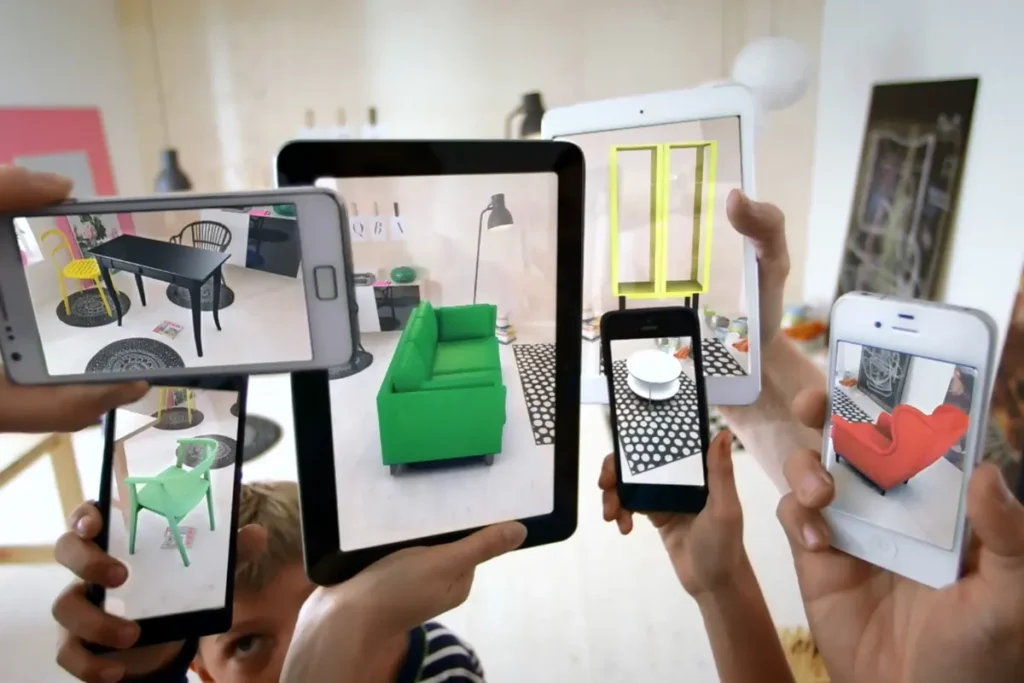
Google research shows that 66% of consumers are willing to use AR as part of their shopping online.
SEO, that is Search Experience Optimization, aims to provide the best possible user experience on their way to conversion, e.g. making a transaction in the e-shop. The user and his purchase intentions are placed in the central place here, and this supports SEO as much as possible. And at the same time, it complies with the pillars of User Experience, that is, UX.
“According to a 2020 study by Vertebrae — which specializes in AR and 3D e-commerce — conversion rates increase by 90% among customers who engage in AR compared to those who don't.
Shopify declares that their product pages with 3D models in augmented reality have increased conversion rates by up to 250%.
They are doing these eCommerce trends well
A great example of using AR is the application IKEA Place on iOS, which allows users “virtually” place furniture in their homes. This solution allows you to make sure that they are properly matched. IKEA was one of the pioneers, which already in 2017 began to use this type of modern solutions.
Since then, countless retailers have followed in their footsteps, including Amazon, Target, or the modern Canadian brand, Parte y todo. This brand has given a very wide opportunity to customize furniture and allowed its users to customize furniture models in 3D. In addition, it allows them to then view them using AR in their interiors.

Let's not forget only, one of the biggest startups in Poland, of which we should all be very proud. Only offers full customization of furniture thanks to an advanced configurator.

Gorgeous photo shoots as a basis in furniture eCommerce
However, let's not leave out the great photo shoots, as a valid basis. A great example of them is again Only. In the research we conducted in the design process for the Yestersen store, users, as the most important element of the interface on the site (right at the price), pointed to the product photos. Both those showing the product in itself and those on scale, in the context of other products.
Customers want to be inspired to buy. The photos testify to the quality of the products and also transfer the experience of the brand into the world, so you can easily identify with it. Thanks to good photos and interesting arrangements, the products become even more attractive. You want to have them.

Many furniture eCommerce stores use the function 'Shop the look', which rearranges beautifully prepared arrangements, evoking many emotions, imaginations and desires. In addition, it is easy for the user to imagine the furniture in some context of use. The user can see a comparison of the product with other furniture, even before switching to the AR option.
Possibility of personalization
Personalization is important not only when choosing furniture, but also in marketing. According to Accenture, 91% of consumers say they are more likely to shop with brands that present offers and products that are right for them.

Customers expect the brand to reach them at the right time, in the right place and with the right message for them. Therefore, it is important to have knowledge about your client. Who and what last bought, when he last visited your site, what he was interested in, etc. This personal approach, showing that you are aware of the needs and preferences of the customer, will allow you to build strong relationships.
Another interesting way to build brand engagement among buyers is to use photos with the looks of your customers. For example, Ikea or Tylko have created special photo galleries. After entering the arrangement, the products used in the styling and the name of the creator's instagram profile are displayed.
This is a very interesting way to get additional buyers' engagement. They can show off their designs, interiors and, above all, things bought on the site. This additionally drives brand marketing, allows you to create additional content.
Visual search
More and more people are shopping using a laptop or mobile devices. Therefore, visual and voice search has gained great popularity.
Visual search is the use of artificial intelligence (AI) that allows buyers to upload an image to a seller's website and locate visually similar products.
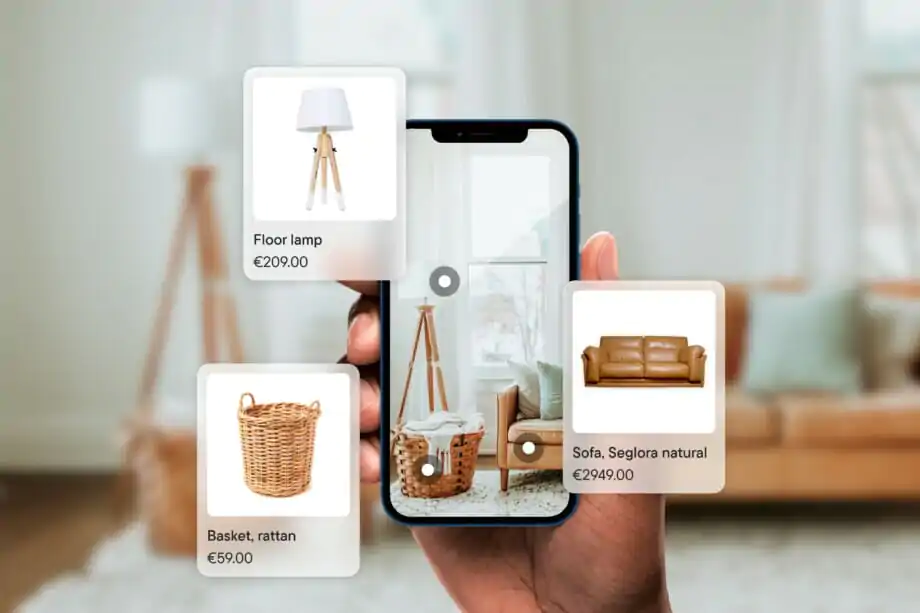
This has a very good application in the furniture industry. After all, it is an incredibly visual industry operating with shapes, colors, materials, finishes and textures. So it's no surprise that more than 36% of online shoppers have used visual search. More than half of them say visual information is more useful to them than text (data from Invespcro).

According to the company's “State of eCommerce Discovery” report Sides, buyers who use visual search tools convert 841% more than buyers who do not use them. Such buyers spend an average of 6.7 times more per session, resulting in 451% more average revenue per user than non-users. Syte is just one of the many examples of this type of software available on the market.
education — a new trend in furniture ecommerce
Increasingly, it can be observed that sites not only sell products, but also Educate in the field of interior design. For example, on Made.com, the user will find many Helpful hints. The brand is divided Know How and Stylistic Inspirationso that the user can feel like an interior designer. When decorating the interior, he can also learn something. It's really winged! When you want to decorate = buy.

MADE also tells you how to care for purchased items so that they last as long as possible. This is a good testimony to the brand, indicates its commitment. It shows what matters to her: awareness about waste generation and saving.
Another interesting example is Ballard Designs, which specializes in classic European designs reinterpreted in a contemporary way. On their website you will find Seasonal Lookbooks that showcase trendy design ideas for your most frequently used spaces.

To increase customer engagement and loyalty, they also lead podcast titled “How to Decorate” with the participation of popular interior designers. Customers can send their questions and designers answer them by sharing great ideas and tips for home decor.
Showing the production process or the designers behind the projects builds awareness about the creation of the products you buy. In addition, it conquers the authenticity of the brand.
Buy now pay later helps shoppers through tough times
Research shows that 43% of millennials and 32% of Gen Z people are very concerned about their finances. This generation is reluctant to spend larger sums of money. To meet them, a lot of buy-now-pay-later-affirm solutions have appeared on the market, thanks to which people make purchasing decisions easier.
Trend Source: Furniture Cart
Unlike credit cards, BNPL is approved faster and does not accumulate debt. This allows customers to make frequent purchases much more confidently. Since 50% of companies report an increase in online sales since the implementation of BNPL, several furniture stores have also started using it.
Some stores introduce their own deferred payment solutions, others opt for specialized solutions in this industry such as e.g. Klarna

Knowledge of trends is not everything
We went through solutions describing the latest trends in e-commerce. It is good to remember that the success of our store does not depend solely on the fact that we implement all these functionalities.
A holistic approach to customer experience design is important. Why? Bo The customer experience of a furniture store does not only happen at the level of the screen — the user. We know that in order to have a real impact on conversion, you need to map the entire customer experience, its strengths and weaknesses. Appropriate transportation can improve the user path; e.g. react in advance to potential problems — manage expectations
and arouse positive emotionse in relation to the brand.
In Winter, we help to use UX to design communication at every stage of the path, designing scenarios also for less pleasant situations.
We often encounter reluctance to conduct in-depth research with users, and Focusing only on numbers. The numbers tell you the scale of the problem, but they don't give insights that tell you what the problem is coming from.
Qualitative data collected during interviews describe Causes of the problemas well as the needs in the area. We recommend combination of numerical and qualitative data. This will help to mitigate the risks arising from the implementation of the solution in question.
It should also be remembered that a key role in analyzing the success of a store's User Experience project is the use of appropriate measures, and distinguishing UX measures from business measures.
We noticed that stores use conversion as the only measure of the success of a given solution. This is not strictly a measure related to user experience. And in measuring UX, it is also important to choose the right measures. Commonly usedmetric HEART: satisfaction (Felicità), involvement (Commitment), adoption, adoption (Adoption), Success in completing the task (Task Success). It is also important Simultaneous collection and analysis of business metrics. They are It's conversion or revenue., which helps to detect associations and strengthen both indicators.
Do you want to develop e-commerce, or maybe you want to talk about your challenges, learn more trends? Write to us! WINTER UX &UI
Read about UX
See other articles that may also be of interest to you
.png)
.png)

.png)
.png)
.png)
.png)









![This is what you need to know to make your medtech business work [+UX examples]](https://cdn.prod.website-files.com/665f016b950e89499f580acc/6a43a79743af9d4fe4319261_ToMusiszWiedziecZeby....png)